
Genetics
The Cannabis Bottleneck & Where We Go Now
Sep
The Future Of Cannabis In A Narrowing Genetic Landscape
I recently published a short post on our social media, where I addressed some of the top-level issues cannabis genetics are facing in today’s breeding culture. The responses indicated that this is something growers are willing to actively prevent. In this article, I’ll run through my current concerns with the trajectory of cannabis genetics, why it matters, and how you can help shape the future by ensuring we don’t lose cannabis as we know it today.
I’ve spent almost a decade diving deep into cannabis genetics, breeding my own plants, and testing them to confirm notions. This guide is written through my personal experience and discussions with respected US-based breeders.
What Is a Genetic Bottleneck in Cannabis
Genetics is at the center of every living thing on Earth. Each group is limited in its abilities by the genetic pool of variables that they’ve inherited. In the same way that our eye and hair colour is determined by our parents and theirs by their own parents, cannabis can only ever express traits that exist within this broad genetic pool.
When humans get involved in the breeding process, we almost always see a narrowing of gene pools, as we weed out undesirable traits in favour of ones that benefit us.
This process, combined with market demands and the fast-moving nature of the cannabis industry, has meant that many growers have opted out of mothering old, unique heirloom strains and instead given that space to modern hybrids that move well on the market.
This behaviour has meant that we have lost strains that at one point were considered the best around. A noteworthy example is Roadkill Skunk, which now has hundreds of growers around the world digging through old seeds trying to find some semblance of what was historically a beloved strain.
Essentially, the cannabis bottleneck has been going on for decades, slowly reducing the amount of true F1 hybrids being made, and breeding work has been focused on stabilizing desirable traits, rather than preserving unique ones.
The Slightly More Technical Side
To get the best understanding of bottlenecking, here’s a visual display of how variability declines over time, typically. This is dependent on how the breeder selects. But with most customers preferring homogeneity, it’s the way it tends to go.
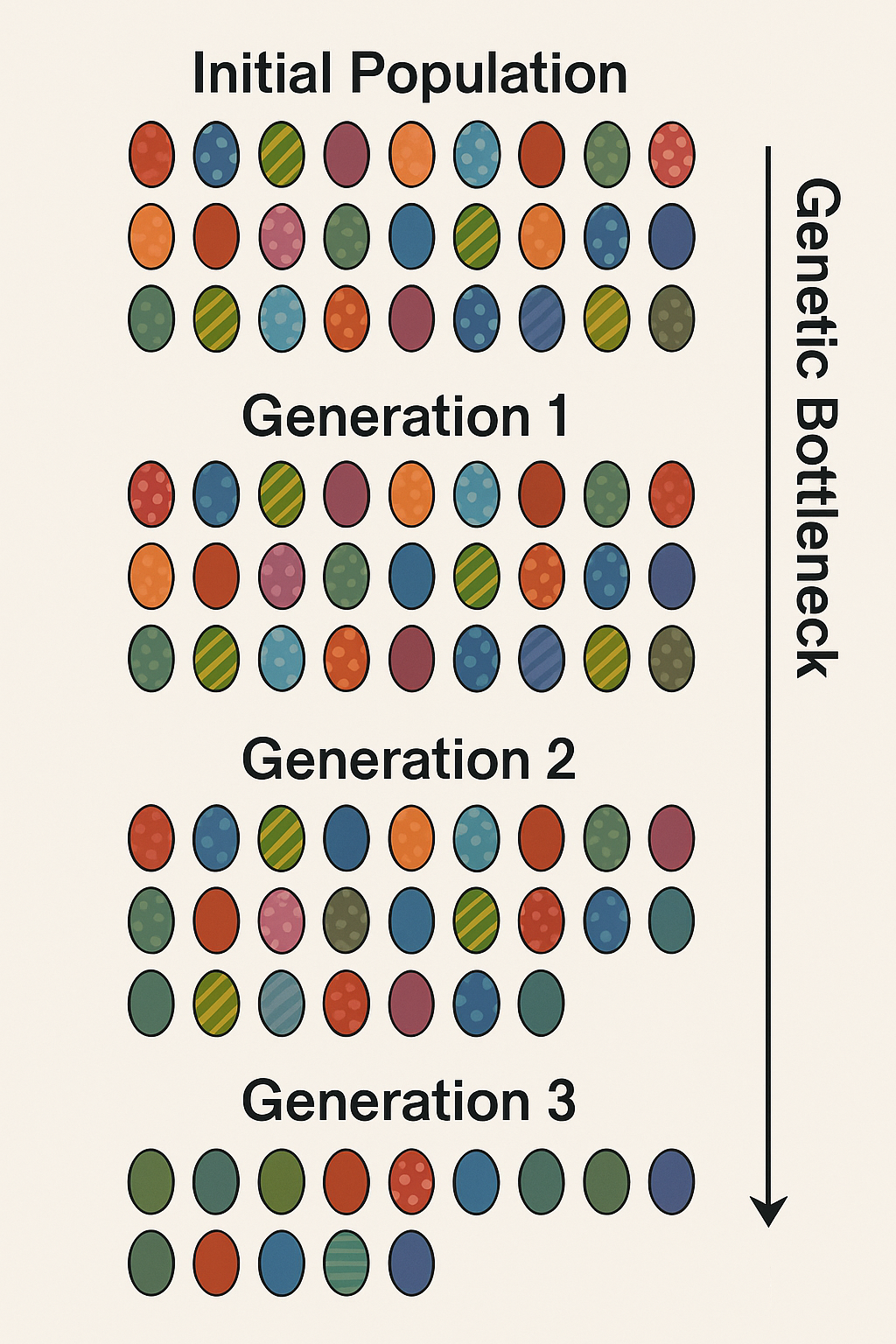
When we talk about a genetic bottleneck, what’s really happening is that the range of alleles within a population is being reduced. Every cannabis plant, like all living things, carries two sets of chromosomes, one from each parent. Along those chromosomes are alleles, the versions of genes that determine traits ranging from terpene production to bud color to resistance against mold. The broader and more diverse the set of alleles in circulation, the more possible outcomes we can see in a breeding project.
The bottleneck begins when breeders repeatedly select only a handful of plants to move forward with. Let’s say out of a hundred seedlings, only two are chosen because they look frosty or have the purple bag appeal that the market wants. The alleles carried by the ninety-eight plants left behind are essentially lost from the working gene pool. Do this over multiple generations, and the allelic diversity shrinks further with every cycle.
Most people think this kind of narrowing leads to uniformity, but it’s a double-edged sword. Yes, the plants may become more consistent in how they look or smell, but under the surface, the genome is becoming more homogenized. That means recessive alleles, or those that might not show themselves in the current generation, get eliminated before they ever have a chance to recombine into something new. The irony is that the traits that could have made future breakthroughs possible are often the first to disappear.
Compounding this is the fact that many cannabis hybrids are already polyhybrids (crosses of crosses) with shared ancestry overlapping multiple times. Incrossing or backcrossing these plants strengthens the expression of dominant traits, but at the cost of reducing variability even further. Over time, what we end up with is a narrowing corridor of outcomes, where every new strain feels like a remix of the same few genetic themes.
This is why outcrossing is so important. By bringing in unrelated lines, whether that’s an old heirloom, a true landrace, or simply a variety not saturated with the same dominant alleles, you create opportunities for recombination that reopen the gene pool. Without that intentional effort, the homogenization continues, and cannabis slowly loses its evolutionary flexibility. That’s the real danger of bottlenecking: once alleles are gone, they’re not easily brought back.
The Cookies Epidemic & Its Role In Bottlenecking
Cookies is both loved and hated, depending on who you ask. But what’s not subjective is its influence on modern cannabis genetics.
Cookies itself is an interesting strain, and the truth is, there still isn’t a clear consensus on what exactly it is. A commonly quoted lineage of Cookies is “Durban Poison x OG Kush”, but that’s complete nonsense.
One needs only look at the physical expressions of Cookies to see that something doesn’t line up. Durban Poison was hardly renowned for its bag appeal, and OG Kush is a classic green plant that doesn’t pass on the kind of purple hues that Cookies is known for.
The Real Cookies Lineage (It’s Not What You May Think)
The more likely situation with Cookies is that there was a lost in translation moment, and the F1 Durb, a completely different clone, got referred to as Durban Poison. The F1 Durban aligns much closer with cookies in terms of appearance.
Regardless of its true lineage, Girl Scout Cookies (Cookies) became massively popular in the 2010s, due in large part to marketing. Berner is a polarizing character, but his ability to market cannot be understated. It only takes a few stealthy bars in a popular rap song to change the trajectory of the market.
Despite popularity in the early 2010s, most of the strain’s hype was centered around California and, at most, the United States. But Cookies caught on like wildfire; suddenly, growers around the world wanted that super frosty, dark plant. The purple backdrop to the dense, bulbous trichome heads immediately brought a ton of bag appeal.
After several years of popularity, the cut became more widely shared, and it was around 2016 when the real Cookies epidemic started in America. It started, like with the flower, in California, when local growers with direct hookup to the Cookies grew started putting out GSC flower in bulk. This meant it was no longer just the Cookies Fam crew and their retailers getting to try it; it was now moving quickly.
By 2020, Girl Scout Cookies had been ingrained into cannabis in a way that we’d never seen before, not even during the earlier Kush rush, where everyone was growing OG Kush.
When The Seed Market Changes and Cookies Became More Dominant Than Ever
The problem was now that it wasn’t just flowers where Cookies dominated; it also dominated the seed industry, with almost every grower basing their strains on some sort of Cookies hybrid. Business-wise, it just makes sense. But one also cannot pretend that this behaviour doesn’t have dramatic consequences of cannabis, that extend far further than we may think.
Most problems in life are temporary; we get sick, we heal, we move on. But once a particular single gene type begins to dominate breeding, there are long-term impacts. Especially because the number of naturally accessible rural cannabis fields is declining with time.
As someone who curates genetics here on Biltong and Budz, I’ve attempted to offer as much variety as possible, sourcing unique landrace genetics too. However, when one looks at what sells and what stays on the shelf, the majority of customers are still looking for modern hyped Cookies hybrids, which also makes sense given that most growers are looking to then move their flower onto the market, where demand is what determines success.
What really made Cookies a problem, though, is its tendency to pass along a lot of the same traits in its hybrids. It is quite dominant, especially the Forum Cut.
So what we’re left with is a seed market which, if you pick any popular pack, chances are you’re going to get some Cookies in there somewhere. And the more this continues, the less likely it is that we’re going to be able to pull ourselves out of this hole.
To demonstrate how dominant the Cookies lineage is in today’s strains, I asked ChatGPT for its top 20 strains for 2025. It answered with the following:
- Wedding Cake
- Super Boof
- Zoap
- Gelonade
- RS-11
- Hash Burger
- Permanent Marker
- Spritzer
- Pink Rozay
- Hella Jelly
While I don’t necessarily agree with the list provided, it serves its purpose in illustrating the point.
Out of these 10 strains, only ONE of them doesn’t have Girl Scout Cookies in the line. But these broader hybrids aren’t as bad for the gene pool as those that have Cookies coming from each parental direction, which is more likely to recombine and strengthen those traits.
The Bigger Picture (It’s Not Just Cookies)
With all of that said, it’s not entirely Cookies’ fault. The truth is, something similar happened years before with OG Kush and Sour Diesel, but both of those tended to hybridize better, with less direct dominance. It also occurred in a different era, before large-scale legalization or decriminalization made everything more popular and widespread. The OG wave was driven mostly by growers, whereas today most strains are heavily curated by the market.
And as much as I personally love OG, it’s also a bit guilty of being thrown into a lot of strains and aiding in the bottleneck. And if we look at today’s modern hybrids, and instead of just looking at Cookies, we also include OG too. Suddenly, we have a broad majority of today’s top-selling strains tied to just two main parent groups.
The reality is, any strain that got the organic and intentional marketing that Cookies did would probably end up dominating. However, its strong bag appeal definitely played a role. Would we be here with a straight green plant like OG or Sour? Probably not.
How Do We Fix The Problem? Is It Too Late?
So you want to be the rare beacon of change that is willing to sacrifice your space to cultivate plants in a way that may preserve the gene pool and widen it, rather than narrowing it? The honest truth is that you have an uphill battle, but all is not lost.
Work With Heirloom Strains
Instead of growing the same hype that everyone else is, consider some pure landrace genetics or unique lineages without modern influence. These strains are often a lot more challenging to grow, especially if you opt for Sativa landraces, which often have long flowering times and are challenging to grow indoors.
The struggles don’t end there, though. One often needs to hunt through a large number of such plants before finding something very unique or worth keeping around.
Nobody said it was easy being a hero.
Create Unique Hybrids
You don’t need to dig all the way back into heirloom varieties. Just start with seeds that have a lineage that is different from modern hype. Even strains like Blueberry, Cinderella 99 (if you can find it these days), etc. are examples of legacy strains that are easy to breed with. But with strains like these having been grown for decades, it may take time to find something special, or maybe just an out-of-the-box hybrid.
Select For Outlying Traits
One of the biggest problems in bottlenecked genetics is something many people don’t talk about, and that’s how breeders make selections in their hybrids. If you’ve got a library of Cookies hybrids already but still want to do something unique, don’t select phenos that express like popular strains.
That really good-looking purple pheno may be calling your name, but there are already 10,000 of them floating around. Do you really need another? Instead, select for outliers. In a pack of seeds that usually express purple, select for the green outlier.
Outcross Before Stabilizing
Incrossing is when two plants with shared lineage are crossed together, for example, crossing two sisters together. But doing this will strengthen those genetics by narrowing them. It reduces the variables and narrows the variation.
Instead of incrossing your seeds, especially if they have modern genetics like OG or Cookies, consider outcrossing them first to something really unique and different. Then when you take the line a step further, select for those same unique traits that don’t typically occur within the other line.
